

I will be presenting a lecture entitled "Beguiling Blasphemy: The Hell-Fire Clubs of the 18th Century", for the University of Bristol Archaeology and Anthropology Society.
Thursday 3rd Feb 2011, 5.30pm.
All welcome, wine reception to follow.



The First BIRTHA Postgraduate Women and Religion Conference will be held at Bristol University on 20 November 2010. The keynote speaker will be Dr Carolyn Muessig, Reader in Medieval Religion in the Theology and Religious Studies department of the University of Bristol, and the concluding address with be given by Dr Martin Seeger, Lecturer in Thai Language and Culture, and Director of Thai Studies at Leeds University. This conference brings together doctoral researchers and early career academics from a variety of disciplines and fields to explore the role and place of women in religion. Presenters will be coming from Universities in the UK and from Europe (France and Italy) and panels will include papers on the role and status of women in Christianity, Buddhism, Judaism and Islam both in the present and historically, and from a wide range of perspectives (textual, sociological, historical). Registration is free but required as the number of places is limited. More information and registration form can be found at http://www.bris.ac.uk/arts/gradschool/community/conferences/


A newly discovered 7th century B.C. palace garden near Jerusalem could reveal details about how royals liked to let loose in ancient times.
Researchers from Tel Aviv University and Germany's Heidelberg University uncovered the royal garden at the site of Ramat Rachel, a kibbutz (communal farm) in Israel, and are leading the first full-scale excavation of this type of archaeological site in Israel.
"We have uncovered a very rare find," archaeologist Oded Lipschits of Tel Aviv University said.
The garden was a massive and lush green space royals would use to relax. Such pleasure spots were once the ultimate symbol of power, according to the researchers.
Read more here

THE oldest ground-edge tool in the world has been discovered in Arnhem Land, prompting scientists to reconsider exactly when the technique of grinding to make tools sharp entered the Stone Age.
Unearthed from a sandstone cave in a remote part of south-west Arnhem Land in May, the basalt axe piece measuring 4 centimetres in length has been radio-carbon dated at 35,000 years old.
The discovery is significant as it predates by at least 5000 years the oldest known examples of other ground-edge implements from Japan and Australia, which have been dated at 22,000 to 30,000 years old. By comparison, the earliest ground-edge axes from Europe, West Asia and Africa are about 8,500 years old.
Full story here

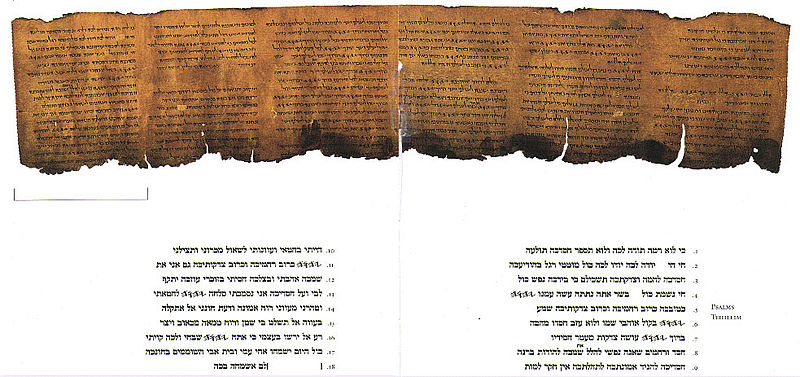
The technology giant and Israel announced Tuesday that they are teaming up to give researchers and the public the first comprehensive and searchable database of the scrolls – a 2,000-year-old collection of Hebrew, Aramaic and Greek documents that shed light on Judaism during biblical times and the origins of Christianity. For years, experts have complained that access to the scrolls has been too limited.
Once the images are up, anyone will be able to peruse exact copies of the original scrolls as well as an English translation of the text on their computer – for free. Officials said the collection, expected to be available within months, will feature sections that have been made more legible thanks to high-tech infrared technology.
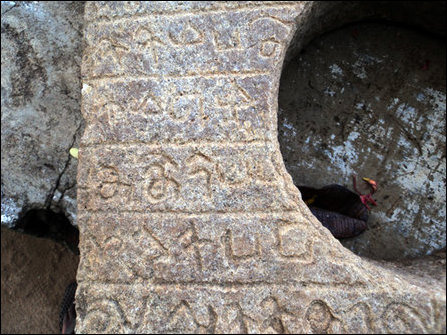
Millennium old Tamil inscription found in Trincomalee
Read more here.

Her life has been celebrated in song, story and a Disney cartoon, but no one knew where Pocahontas tied the knot with a tobacco farmer—until now.
Archaeologist Bill Kelso and his team were digging this summer in a previously unexplored section of the fort at Jamestown, Va., the country's oldest permanent English colony, when they uncovered a series of deep holes. They believe the holes once anchored heavy, timber columns supporting the fort's first church, known to have been built in 1608 and the place where Pocahontas got married in 1614
Read more of Kelly Crow's article here.
The 21st century's three Rs -- Reduce, Reuse, Recycle -- were all the rage in Britain during the last century of Roman rule, a compositional analysis of ancient Roman glass tableware has revealed.
According to the study, published in the Journal of Archaeological Science, large quantities of glass were recycled in Britain during the 3rd and 4th centuries A.D.
The reason wasn’t exactly a desire to go green, but a shortage of raw glass in the northern regions of the Roman Empire during the last centuries of Roman rule.
“It appears much of the glass reaching Britain in the late Roman period was manufactured from recycled material,” Caroline Jackson, at the archaeology department of the University of Sheffield, U.K., told Discovery News.
Believed to have originated in Mesopotamia around 2500 B.C., the art of glass-making spread to Egypt, with the most significant technological revolution -- glass blowing employing a tube -- occurring in the 1st century B.C. in the area of Syria and Palestine.
The Romans exploited the technique, and glass-making spread throughout the empire, with glass becoming a common household material.
Made out of sand, glass takes on the color of the chemical elements present in raw material. For example, sand containing iron produces blue-green glass, while iron and sulfur elements make a brownish glass.
Skilled Roman craftsmen were able to control glass color through a careful selection of the raw materials, and produced colorless glass by adding a decolorizer, an element which oxidizes the chemicals in the sand to remove the color.
“In the Roman period, this element would have been antimony or manganese,” said Jackson.
Resembling crystal, colorless glass was much valued. According to the Roman author, Pliny, the emperor Nero (37-68 A.D.) gave 6,000 sestertia (roughly $250,000) for two clear glass cups of ordinary size, with handles.
A highly developed and successful industry, Roman glass-making still holds some mystery. It is unknown where colorless glass was produced, and scholars still debate how the glass industry was organized.
Read more of Rossella Lorenzi's article here (Discover.com)
East China's Jiangxi Province will launch an underwater archaeological investigation in Poyang Lake next month, China's first such project in inland waters.
"This time, we will go into China's largest fresh-water lake to study its repository of underwater sites and artifacts," said Fan Changsheng, director of Jiangxi Provincial Institute of Archeology.
Archaeologists will start by identifying submerged indigenous sites, waterlogged ancient battlefields, and shipwrecks at "Laoyemiao" , a mysterious and dangerous area in Poyang Lake, according to Fan.
World-class equipment, including advanced sonar sound machines and sand pumps, will be used for the mission, said Fan.
The development of China's underwater archaeology began in the late 1980s when China start salvaging its ancient shipwrecks. While a new field of exploration, it has seen rapid development in recent years.
"China has previously conducted several maritime archaeological projects in its coastal regions, but this will be the first time it will take place in the country's fresh waters," said Fan.
Along with Laoyemiao, the Anhui sections of the Yangtze and Huaihe rivers have been selected as the second coveted spot for such underwater archaeological studies.
Laoyemiao, a narrow water channel linking Poyang Lake and the Yangtze River, was chosen for its historical and archeological significance.According to Fan, ancient vessels carrying famous Jingdezhen-made porcelain ware had to pass this gateway before heading out to destinations outside China.
Read more here

John Roach at National Geographic News has a lot to say about an odd pyramid that had rooftop homes and possible ritual sacrifices ... At rare Peru site, elites linked to copper industry lived on high, experts say.
Yes, it's yielded human remains—including five females who may have been ritually sacrificed. But it's the signs of life that make a half-excavated Peruvian pyramid of the Moche culture stand out, archaeologists say.
"Often these pyramidal mounds were built as mortuaries more than anything else," said excavation co-leader Edward Swenson. (See pictures from the tomb of the Moche "king of bling.")
"In most instances [a pyramid] is not where people live, it is not where they were cooking their food," the University of Toronto archaeologist added.
But the newly exposed 1,400-year-old flat-topped pyramid supported residences for up to a couple dozen elites, who oversaw and perhaps took part in copper production at the site, evidence suggests.
The pre-Inca pyramid dwellers likely presided over important rituals, feasted on roasted llama and guinea pig, and drank corn beer, according to archaeologists working at the site.
Among the signs of occupation are at least 19 adobe stands where large vessels of water and corn beer were stored, as well as scattered llama, dog, guinea pig, and fish bones and traces of coca leaves and red peppers.
"There's a far more robust domestic occupation than what we would have expected," said expedition co-leader John Warner, an archaeologist with the University of Kentucky.
Read more of his great article here.
In the news today:
Headland Archaeology today officially launched an office in Dublin, adding to its Cork, Galway, Belfast, Edinburgh, Glasgow and London locations.
The new office will create five new jobs immediately, with a further 30 roles expected over the next 12 months.
The company, which supplies commercial archaeology services to the UK, Ireland and Europe, said the establishment of a permanent office in Dublin was “the next logical step”."
So, really five jobs have been created - yes, great, but is this really news worthy?
Is that the level of desperation we are at now that 5 new jobs and a probable 30 more is the stuff of headlines??? Especially with no actual guarantee of the 30 other jobs.
Oh dear, archaeology has really been hit hard!


