David Bowie's Labyrinth was a major part of my childhood and concreted ideas of what was mysterious and magical. One of the coolest parts of the movie was Bowie's crystal ball juggling scene.
What has that got to do with Archaeology or History, you ask? Nothing really, but by chance I found Penn Museum's incredible Chinese Rotunda section which features as its centre piece a perfect quartz crystal ball. This is the second largest in the world and absolutely stunning. Click here to see the museum's official photos.

If you would like to know a bit more about the science of the quartz ball click here. The history of the piece is mind-blowing too. The text from the exhibition states:
An ornamental treasure of the Imperial palace in Beijing, the crystal sphere was said to have been a favorite possession of the Empress Dowager Cixi (1836 -1908 CE), under whose watch imperial China crumbled. The rock crystal originated in Burma and was shaped into a sphere though years of constant rotation in a semi-cylindrical container filled with emery, garnet powder, and water. The forty-nine pound flawless crystal sphere is believed to be the second largest in the world. The stand in the shape of a wave was designed by a Japanese artisan.
 |
| See how I completely avoided any 'ball' related jokes.... |
 |
| Source: Penn Museum http://www.flickr.com/photos/pennmuseum/5527144310/in/set-72157620815557453 |
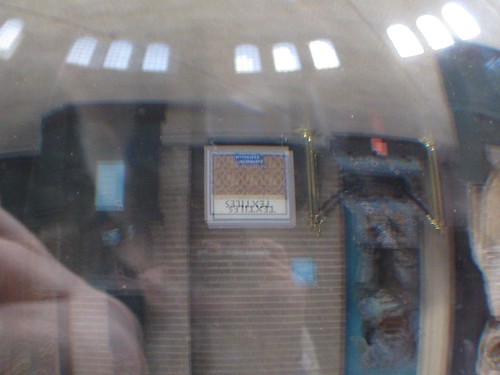
The base was designed by a Japanese artisan and really showcases the grace and simplicity of the crystal ball. The properties of quartz make the piece even more special: it has special optical properties because of the way light travels through the material... something about its structure atomic lattice. One of the easiest ways to observe such properties is the way it turns everything upside down and then creates a kind of double vision.
If you would like to know a bit more about the science of the quartz ball click here. The history of the piece is mind-blowing too. The text from the exhibition states:
An ornamental treasure of the Imperial palace in Beijing, the crystal sphere was said to have been a favorite possession of the Empress Dowager Cixi (1836 -1908 CE), under whose watch imperial China crumbled. The rock crystal originated in Burma and was shaped into a sphere though years of constant rotation in a semi-cylindrical container filled with emery, garnet powder, and water. The forty-nine pound flawless crystal sphere is believed to be the second largest in the world. The stand in the shape of a wave was designed by a Japanese artisan.


