Thursday, September 15, 2011

Ireland's utter stupidity when it comes to its heritage

Prepare for sarcasm and rage.

Some genius has come up with an idea to get rid of that pesky need to protect historic buildings by removing them from a protected register. The Department of Arts, Heritage and the Gaeltacht want all structures from 1700 taken off the Record of Monuments and Places. Just a blanket removal - you know, because nothing interesting or important was built after 1700 (grrrrrr) (canals, industrialisation, Georgian-era architecture, etc.). The Department made some hazy comment about not all counties being consistent in their recording of such buildings, is that meant to be an excuse for this ridiculous planned change? This type of "standardisation" will not, as they posit, "ensure that all elements of the built heritage continue to be adequately protected". The whole thing smacks of budget cuts and sneaky back door planning deals.

I'm sure a rage comic could be made of this fiasco

I am so full of rage about all this! It is utterly disgraceful. Compare this, like another archaeologist quoted in the original article did, to American or Australian heritage and how they treasure the last 300 years. They have heritage from much farther back than that, but they also understand that the past few hundred years shaped the modern world they live in. Every aspect of the past should be treated with the same regard, whether 10,000 years ago, 1,000 years ago or 100 years ago. Setting such a cut off point is arbitrary and destructive. It states, in effect, that history and archaeology from the last 300 years is less important than what came before.

In my own experience, many archaeologists excavating sites tend to disregard the 18th century in their reports, preferring to focus on the medieval, bronze age, etc. (based on my reading of archaeological reports from Limerick city). This proposal justifies that bias.

As an example of this bias even before such a proposal has been sanctioned:

In Askeaton, Co. Limerick, the Office of Public Works (OPW) was instructed to repair the unstable quay walls of the 18th century Hell-Fire Club (one of only two such clubs in Ireland), in addition to repairs to the castle (13th-16th century) on the same site. This year when I went to visit the site for some recording work, one of the wonderful men working there informed me that budget cuts were now in force. All the repairs to the 18th century building were cancelled, while work still continued on the castle. The men on site, fearing for the club house thoughtfully left some scaffolding lattice over the brickwork which had been partially cleaned and destabilised. Preference was given to protecting the castle. When I asked for any reports on this, any evidence of discussion and justification for the work, it seemed that that doesn't really exist in the public domain (I'm going to try to track it down with gusto soon). I'm not annoyed that they are repairing the castle, it needs and deserves it. It is just terribly worrying that such an unusual building as the Hell-Fire Club is left to crumble because it is from a later time period.

I don't want to just focus on my own studies, so here is an unbiased Wikipedia recounting of some important things that happened in the last 300 years, unedited:

I'm under the impression that some of these events took place in "buildings" and that the "structures" may be deemed important by some people


I could rant some more, but I think it's best if I stop now. Still fuming. May return to this topic in the future.

EDIT: Loads more useful information on the issue here http://irisharchaeology.ie/2011/09/proposal-to-de-list-archaeological-and-historical-sites-that-post-date-1700/

Another great mystery!

Who doesn't like an enigma, an unknown site that just begs to be figured out? Though half the fun is never really knowing.

Lying between Syria and Saudi Arabia are the remains of thousands of ancient geoglyphs. Aerial photography and satellite mapping over Jordan has unearthed truly fascinating designs across desert plains. While there is a variety of size (25m to 70m diameter) and design, the core repeated motif is that of a circle with internal radiating spokes.

Dating is problematic for such sites, but is is believed that that are at least 2,000 years old. Comparisons have been made to the famous Nazca lines, but those of Jordan are more ancient and more numerous.

These circles or wheels are thought to be part of a larger stone landscape which includes kites (for funneling animals), pendants (lines of cairns that run from burials) and other structures. The practicalities of such structures are not always immediately obvious.

Without excavated data on the sites, it is difficult to determine exact details of age and function.

Comment:
While I haven't studied these at all, it seems possible that they could have been settlement sites (maybe temporary ones). I also believe that the comparison with the Nazca lines is not very helpful, if anything, it somewhat impedes independent analysis. But that's journalism for you, it sounds juicer if they can link it to a more famous site.

For more resources from the researches, click here: http://www.flickr.com/photos/apaame
For more images, click here: http://www.livescience.com/16045-aerial-photos-mysterious-stone-structures.html
Source: http://www.cbsnews.com/stories/2011/09/15/scitech/main20106680.shtml

Ancient Armenian Attire

Without pics it is difficult to get a feel for this story, but I can't wait to see what they dug up. Archaeologists report that they found the remains of a dress in Armenia. Multicoloured and made of straw, the dress is believed to be about 5,900 years old, according to Pavel Avetisian, director of the Institute of Archaeology and Ethnology at Armenia's Academy of Sciences. The presumption is that it belonged to a woman. This is from the same site that identified the world's oldest known leather shoe and most ancient winery. The dating of the dress was conducted by the University of California who are also restoring the dress.

Source: http://news.ninemsn.com.au/entertainment/8302445/ancient-straw-dress-found-in-armenian-cave

Insanity of the internet

I don't even....

Monday, September 12, 2011

Friday, September 2, 2011

Upsetting Archaeology: The murder of newborns

It's a reality in archaeology that we deal with death on a regular basis, but telling the story of a life passed can give it new meaning and recall a past once lost. Sometimes though, death can be too painful for an archaeologist to come to terms with. That's what happened to one excavator, A H Cocks, back in the 1912.

At Yewden Villa, a brothel was uncovered by Cocks. The chilling discovery of 97 skeletons of newborns, both boys and girls, went near-ignored by the archaeologist, who focused on the pottery finds. The remains of the children were classified 'various' and stored in cigarette boxes at the Aylesbury Museum. In 2008, Dr. Jill Eyers, director of Chiltern Archaeology, found the bones and immediately became unnerved as they were all the same age (38 to 40 weeks gestation) and showed marks of foul play. For three nights, she was kept awake by nightmares, disturbed by how the children had met their end. She believes that Cocks was unable to face the truth of his findings.

At the time, 150AD to 200AD, there was no viable form of abortion. The prostitutes had no place for the newborns, so they were immediately killed at birth. Simon Mays, a paleontologist, spent a year measuring the bones and confirmed Eyers suspicions, countering the notion that the site was a birthing centre.

Read more here

Material Culture: 9/11 and Ground Zero

"Excavating Ground Zero: Fragments from 9/11" is Penn Museum's latest exhibition offering. Housed in a small room, some 15 objects retrieved from Ground Zero are displayed alongside video footage, photographs and information panels detailing the terrorist attacks on New York's World Trade Centre.
Visitors are invited to respond to the exhibition and recount their own experiences in written form. The simple every day objects recovered from the site by archaeologists and anthropologists (a melted keyboard, glasses, a visitor badge, window glass) evoke remembrance of the ordinary people who lost their lives on that day.

The events of 9/11 are ingrained on the USA's collective conciousness. This display will hit a nerve for many, but its small-scale approach (rather than a multi-level exhibition) will hopefully create a more personal and intimate experience for visitors, avoiding a shock-factor show. See more: www.penn.museum

Thursday, August 25, 2011

Minecraft and Archaeology?

Combining two of my favourite things? Almost, not quite, not really... Some fellow gamer decided to visit an abandoned server and treat it like an archaeologist. Mostly he just looked around and guessed what things might have been. So, yes, in some ways like an archaeologist would, but there was no methodology, ha! Anyway, here is his diary entry:

How to fool the art world

Tuesday, August 23, 2011

Stonehenge: Druid loses human rights battle over reburial of 5,000 year old remains

Anyone familiar with British Archaeology, and in particular Stonehenge, will have heard of the famous Druid, King Arthur Pendragon. Quite the character, he has been featured on countless news outlets over the years.

His latest battle at the the High Courts in London was rejected. Mr. Pendragon asked that remains uncovered in 2008 be denied further scientific study and return for burial at Stonehenge. Representing himself, Mr. Pendragon claimed that the bodies represented the 'founding fathers' of the British nation, that they hold a special place of respect and deserve, like any human remains, to rest undisturbed, 'Let those we lay to rest, stay in rest'.

A judicial review action was denied to Mr. Pendragon by Mr. Justice Wyn Williams based on insufficient evidence that the Ministry of Justice have acted unreasonably. Mr. Pendragon subsequently called for a 'Day of Action' at Stonehenge.

Mr. Pendragon's arguments, while not of the highest legal calibre, do generate debate on the topic of exhumation and reburial. The ethics of how to deal with human remains are often overlooked by archaeologists, but there is always room for and a need for debate on the subject to ensure ethical progress within the discipline.

More on this story here, here, here and here.

Paintballs vs Petroglyphs

Some people have no interest in history or archaeology, that's just fine. But when people have no respect for ancient remains, that can be a dangerous thing with serious consequences. For one David R. Smith, he found out the hard way via the U.S. Attorney's Office.
Grapevine Canyon defaced petroglyphs
Back in March of last year, 21 year old Smith and two others took their fully automatic paintball guns out to the site of the petroglyphs, showering Grapevine Canyon with hundreds of oil-based red and green paint bullets. 38 of the bullets seriously defaced the petroglyphs, and while the paint has been removed, an oily residue still remains.

Grapevine Canyon is a sacred place to the Colorado River Indian tribes and home to 700 petroglyphs that are listed on the National Register of Historic Places.

Yesterday, Smith pleaded guilty to the crime and was sentenced to 15 months in prison and an order to pay nearly $10,000 in restitution.

Source: here.

Kellogs - away with the birds

Multi-million-dollar, international corporation, Kellogs (of cereal fame) have decided to take to the courts over their bird, Toucan Sam:.
Kellogs claim, in their copyright suit, that a non-profit company based in California is ripping off their logo. That non-profit is the Maya Archaeology Initiative, whose sole purpose is to defend Mayan culture. Now, correct me if I'm wrong, but the two birds do not look the same. Both abstracted in their own way, they differ immensely in style, one cartoon, one stylistically Mayan, with a Mayan pyramid in the background for emphasis. Featuring different colours, proportions, and context, the mind boggles as to how and why Kellogs think they will win. Copyright infringement is taken very seriously by big multinationals and rightly so. Confusing customers can lead to lost profits, but in this case, Kellogs is out of their mind. The two logos' only similarity is their basis on the Toucan. Does that mean that Kellogs owns the image rights to the Toucan.... will they start suing other companies...?
Call me biased
No, wait, Guinness is also a mega multinational, no chance of them not using the Toucan. So instead Kellogs goes after the little guy, the one that is not out to make millions but preserve the cultural legacy of the Mayan people. In any case, the two logos don't even operate in the same industries, so how would a customer get confused? Why would the non-profits use of the logo detract from Kellogs' area of operations?

The simple answer is Kellogs has made a major PR blunder while the Maya Archaeology Initiative will hopefully have gained some much needed free press.


 Read more here and here. Also, http://mayaarchaeology.org/

Friday, August 19, 2011

Spain: Operation Necropolis

Spanish police squads may sound like comic book super-villains, but they get the job done! 'Operation Necropolis', recently arrested 12 people in connection with the looting and selling of thousands of archaeological artefacts from the Valencia area. More than 9,000 antiquities were seized in the early morning raids on 13 homes in the region. Metal detectors, maps and other equipment were found alongside pillaged coins and medallions.

Spain has done a fantastic job with this. The country is very hands-on with protecting its cultural heritage and is usually one of the first to sign new legislation that protects its archaeology. Other countries could certainly take a few pointers on how to manage looters and the black market trading that is omni-present globally.
Read the original story here.

First day of real archaeology (rage comic)


David Bowie, China and Crystal Balls

David Bowie's Labyrinth was a major part of my childhood and concreted ideas of what was mysterious and magical. One of the coolest parts of the movie was Bowie's crystal ball juggling scene.
See how I completely avoided any 'ball' related jokes....
What has that got to do with Archaeology or History, you ask? Nothing really, but by chance I found Penn Museum's incredible Chinese Rotunda section which features as its centre piece a perfect quartz crystal ball. This is the second largest in the world and absolutely stunning. Click here to see the museum's official photos.
Source: Penn Museum http://www.flickr.com/photos/pennmuseum/5527144310/in/set-72157620815557453
The base was designed by a Japanese artisan and really showcases the grace and simplicity of the crystal ball. The properties of quartz make the piece even more special: it has special optical properties because of the way light travels through the material... something about its structure atomic lattice. One of the easiest ways to observe such properties is the way it turns everything upside down and then creates a kind of double vision.

If you would like to know a bit more about the science of the quartz ball click here. The history of the piece is mind-blowing too. The text from the exhibition states:


An ornamental treasure of the Imperial palace in Beijing, the crystal sphere was said to have been a favorite possession of the Empress Dowager Cixi (1836 -1908 CE), under whose watch imperial China crumbled. The rock crystal originated in Burma and was shaped into a sphere though years of constant rotation in a semi-cylindrical container filled with emery, garnet powder, and water. The forty-nine pound flawless crystal sphere is believed to be the second largest in the world. The stand in the shape of a wave was designed by a Japanese artisan.


Saturday, August 13, 2011

Ireland: Bagged up Bog Body


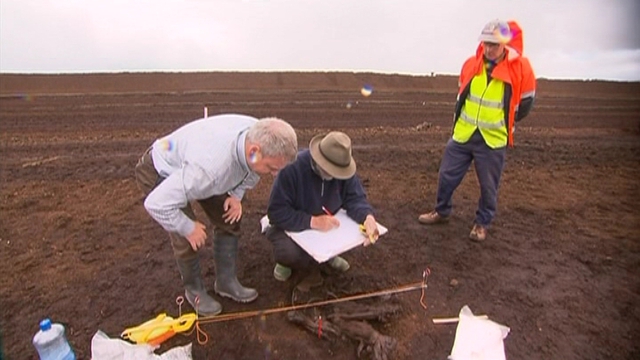
A bog body was found part-buried in a leather bag in Portloaise by Bórd na Móna diggers yesterday - saved in the nick of time from the machine cutters by a keen-eyed employee. Now removed for study at the National Museum, the remains are believed to be 3000 years old. Chemicals in the surrounding peat preserved the exposed legs and leather bag, but the torso, head and arms that were covered in the leather bag did not survive. The area surrounding the remains has provided a number of exciting archaeological finds in recent years, including an axe heads, shoes and bog butter.

Read RTÉ's story here, including more pics.

Wednesday, August 10, 2011

Historian tackles more than the past

TV Presenter Dan Snow tackled a looter outside his home in London. Hearing the windows of his local pub smashed in, Snow rushed out onto the street. A youth ran past him, preoccupied with carrying looted shoes. The historian told BBC 5 live Breakfast how he seized the opportunity to tackle him to the ground and then sat on the looter until police arrived.

On a complete side note, while looking up a picture of him on the internets, I found lots of people have taken a strong fancy to his face, while another had this snarly piece to say:

National Archives UK - Posters

These posters provide a fascinating insight into the British views on trade and empire, and are very much of their time (!)

First, putting a positive spin on decimating forestry with a hint of racist overtones:
"Jungles today are gold mines tomorrow" 1927
From the days when construction workers were regarded with a bit more respect as 'Empire Builders':
"Empire Builders" 1927

A time when the world wasn't made of individual cultures and countries, but easy routes through which to travel to your newest resource, with lands owned by the crown marked in blood red:
"Highways of Empire" 1927

Not only could you look to your explorers for new lands to conquer, but also the history of fashion:
"The Empire is Still in Building" 1930
There is plenty more on the Empire and other topics on the National Archives website, Education section. Source for the above at http://www.nationalarchives.gov.uk/education/empire/g2/cs1/default.htm

Monday, August 1, 2011

Mystery object found on the ocean floor between Sweden and Finland

No one has any idea what this 'floundering object' is 285 feet down Botnia Gulf.


Peter Lindberg, commander of Ocean Explorer, and his team of experienced salvage hunters haven't a clue either.


Find out more, including a detailed image, here. Let's figure this one people!


And NO, Giorgio, it's not bloody aliens