Monday, October 25, 2010

The wonders of the internet - Dead Sea Scrolls to go online


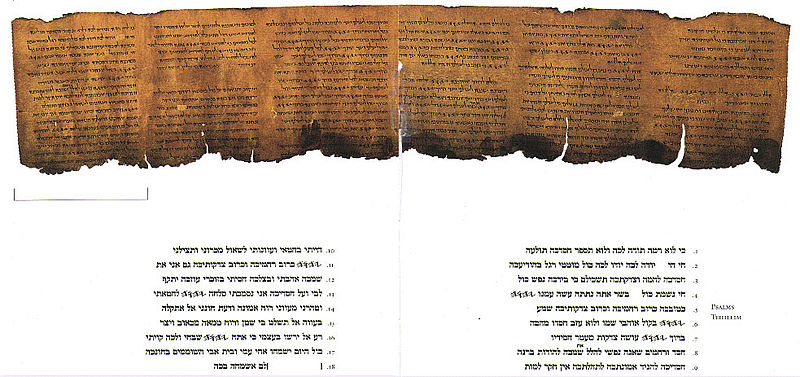
The Dead Sea Scrolls, among the world's most important, mysterious and tightly restricted archaeological treasures, are about to get Googled.

The technology giant and Israel announced Tuesday that they are teaming up to give researchers and the public the first comprehensive and searchable database of the scrolls – a 2,000-year-old collection of Hebrew, Aramaic and Greek documents that shed light on Judaism during biblical times and the origins of Christianity. For years, experts have complained that access to the scrolls has been too limited.

Once the images are up, anyone will be able to peruse exact copies of the original scrolls as well as an English translation of the text on their computer – for free. Officials said the collection, expected to be available within months, will feature sections that have been made more legible thanks to high-tech infrared technology.


Read more: http://acn.liveauctioneers.com/index.php/component/content/article/3353?utm_source=feedburner&utm_medium=email&utm_campaign=Feed%3A+ACNlatestnews+%28Auction+Central+News+-+Latest+News%29#ixzz13MwgrpW3

Saturday, October 23, 2010

Trincomalee - Tamil Tablet


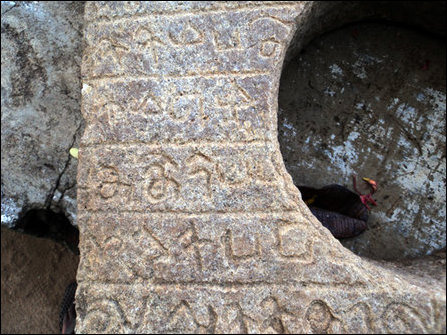
Millennium old Tamil inscription found in Trincomalee

A stone slab having a Tamil inscription, clearly in the alphabet of the Chola times, was found in Trincomalee while digging for cricket stadium construction work recently. The land where it was found is a part of the esplanade, on the right side of the Koa’neasvaram Road leading to the Siva temple inside Fort Frederick and is adjacent to the bay where the temple’s Theerththam (water cutting) ritual is held. Sometimes back, a Buddhist Vihara and another structure called Sanghamitta Buddhist Rest were constructed at this place. The inscribed slab was taken into possession by the Trincomalee police and was sent to the Department of Archaeology in Colombo.

Read more here.

Bridal colours of the wind?


Her life has been celebrated in song, story and a Disney cartoon, but no one knew where Pocahontas tied the knot with a tobacco farmer—until now.

Archaeologist Bill Kelso and his team were digging this summer in a previously unexplored section of the fort at Jamestown, Va., the country's oldest permanent English colony, when they uncovered a series of deep holes. They believe the holes once anchored heavy, timber columns supporting the fort's first church, known to have been built in 1608 and the place where Pocahontas got married in 1614

Read more of Kelly Crow's article here.

Recycling Romans!

The 21st century's three Rs -- Reduce, Reuse, Recycle -- were all the rage in Britain during the last century of Roman rule, a compositional analysis of ancient Roman glass tableware has revealed.

According to the study, published in the Journal of Archaeological Science, large quantities of glass were recycled in Britain during the 3rd and 4th centuries A.D.

The reason wasn’t exactly a desire to go green, but a shortage of raw glass in the northern regions of the Roman Empire during the last centuries of Roman rule.

“It appears much of the glass reaching Britain in the late Roman period was manufactured from recycled material,” Caroline Jackson, at the archaeology department of the University of Sheffield, U.K., told Discovery News.

Believed to have originated in Mesopotamia around 2500 B.C., the art of glass-making spread to Egypt, with the most significant technological revolution -- glass blowing employing a tube -- occurring in the 1st century B.C. in the area of Syria and Palestine.

The Romans exploited the technique, and glass-making spread throughout the empire, with glass becoming a common household material.

Made out of sand, glass takes on the color of the chemical elements present in raw material. For example, sand containing iron produces blue-green glass, while iron and sulfur elements make a brownish glass.

Skilled Roman craftsmen were able to control glass color through a careful selection of the raw materials, and produced colorless glass by adding a decolorizer, an element which oxidizes the chemicals in the sand to remove the color.

“In the Roman period, this element would have been antimony or manganese,” said Jackson.

Resembling crystal, colorless glass was much valued. According to the Roman author, Pliny, the emperor Nero (37-68 A.D.) gave 6,000 sestertia (roughly $250,000) for two clear glass cups of ordinary size, with handles.

A highly developed and successful industry, Roman glass-making still holds some mystery. It is unknown where colorless glass was produced, and scholars still debate how the glass industry was organized.

Read more of Rossella Lorenzi's article here (Discover.com)

Friday, October 22, 2010

China's inland waterways under archaeological investigation

East China's Jiangxi Province will launch an underwater archaeological investigation in Poyang Lake next month, China's first such project in inland waters.

"This time, we will go into China's largest fresh-water lake to study its repository of underwater sites and artifacts," said Fan Changsheng, director of Jiangxi Provincial Institute of Archeology.

Archaeologists will start by identifying submerged indigenous sites, waterlogged ancient battlefields, and shipwrecks at "Laoyemiao" , a mysterious and dangerous area in Poyang Lake, according to Fan.

World-class equipment, including advanced sonar sound machines and sand pumps, will be used for the mission, said Fan.

The development of China's underwater archaeology began in the late 1980s when China start salvaging its ancient shipwrecks. While a new field of exploration, it has seen rapid development in recent years.

"China has previously conducted several maritime archaeological projects in its coastal regions, but this will be the first time it will take place in the country's fresh waters," said Fan.

Along with Laoyemiao, the Anhui sections of the Yangtze and Huaihe rivers have been selected as the second coveted spot for such underwater archaeological studies.

Laoyemiao, a narrow water channel linking Poyang Lake and the Yangtze River, was chosen for its historical and archeological significance.According to Fan, ancient vessels carrying famous Jingdezhen-made porcelain ware had to pass this gateway before heading out to destinations outside China.

Read more here

Pyramids, with homes on top?


John Roach at National Geographic News has a lot to say about an odd pyramid that had rooftop homes and possible ritual sacrifices ... At rare Peru site, elites linked to copper industry lived on high, experts say.

Yes, it's yielded human remains—including five females who may have been ritually sacrificed. But it's the signs of life that make a half-excavated Peruvian pyramid of the Moche culture stand out, archaeologists say.

"Often these pyramidal mounds were built as mortuaries more than anything else," said excavation co-leader Edward Swenson. (See pictures from the tomb of the Moche "king of bling.")

"In most instances [a pyramid] is not where people live, it is not where they were cooking their food," the University of Toronto archaeologist added.

But the newly exposed 1,400-year-old flat-topped pyramid supported residences for up to a couple dozen elites, who oversaw and perhaps took part in copper production at the site, evidence suggests.

The pre-Inca pyramid dwellers likely presided over important rituals, feasted on roasted llama and guinea pig, and drank corn beer, according to archaeologists working at the site.

Among the signs of occupation are at least 19 adobe stands where large vessels of water and corn beer were stored, as well as scattered llama, dog, guinea pig, and fish bones and traces of coca leaves and red peppers.

"There's a far more robust domestic occupation than what we would have expected," said expedition co-leader John Warner, an archaeologist with the University of Kentucky.

Read more of his great article here.

35 new archaeology jobs created (kind of)

In the news today:

"Headland Archaeology to create 35 jobs

Headland Archaeology today officially launched an office in Dublin, adding to its Cork, Galway, Belfast, Edinburgh, Glasgow and London locations.

The new office will create five new jobs immediately, with a further 30 roles expected over the next 12 months.

The company, which supplies commercial archaeology services to the UK, Ireland and Europe, said the establishment of a permanent office in Dublin was “the next logical step”."

So, really five jobs have been created - yes, great, but is this really news worthy?

Is that the level of desperation we are at now that 5 new jobs and a probable 30 more is the stuff of headlines??? Especially with no actual guarantee of the 30 other jobs.

Oh dear, archaeology has really been hit hard!


Thursday, October 21, 2010

Knock, knock on 5,00 year old door


Archaeologists in the Swiss city of Zurich have unearthed a 5,000-year-old door that may be one of the oldest ever found in Europe.

The ancient poplar wood door is "solid and elegant" with well-preserved hinges and a "remarkable" design for holding the boards together, chief archaeologist Niels Bleicher said Wednesday.

Using tree rings to determine its age, Bleicher believes the door could have been made in the year 3,063 B.C. — around the time that construction on Britain's world famous Stonehenge monument began.

"The door is very remarkable because of the way the planks were held together," Bleicher told The Associated Press.

Harsh climatic conditions at the time meant people had to build solid houses that would keep out much of the cold wind that blew across Lake Zurich, and the door would have helped, he said. "It's a clever design that even looks good."

The door was part of a settlement of so-called "stilt houses" frequently found near lakes about a thousand years after agriculture and animal husbandry were first introduced to the pre-Alpine region.

It is similar to another door found in nearby Pfaeffikon, while a third — made from one solid piece of wood — is believed to be even older, possibly dating back to 3,700 B.C., said Bleicher.

The latest find was discovered at the dig for what is intended to be a new underground car park for Zurich's opera house.

Archaeologists have found traces of at least five Neolithic villages believed to have existed at the site between 3,700 and 2,500 years B.C., including objects such as a flint dagger from what is now Italy and an elaborate hunting bow.


Source: click here

Monday, September 27, 2010

It's all Greek to me!


One of the world's most important caches of Greek manuscripts is going online, part of a growing number of ancient documents to hit the Web in recent years.

The British Library said Monday that it was making more than a quarter of its 1,000 volume-strong collection of handwritten Greek texts available online free of charge, something curators there hope will be a boon to historians, biblical scholars and students of classical Greece alike.

Although the manuscripts — highlights of which include a famous collection of Aesopic fables discovered on Mount Athos in 1844 — have long been available to scholars who made the trip to the British Library's reading rooms, curator Scot McKendrick said their posting to the web was opening antiquity to the entire world.
Source/Read more here

Set Sail for Singapore!


The Freer Gallery of Art and Arthur M. Sackler Gallery of the Smithsonian Institution in Washington, D.C., the Singapore Tourism Board and the National Heritage Board of Singapore today announced a partnership to organize the first exhibition and international tour of one of the oldest and most important marine archaeological finds of the late 20th century. The exhibition will focus on the 1998 discovery of a ninth-century shipwreck and its astonishing cargo of about 60,000 objects from Tang dynasty China, ranging from mass-produced ceramics to rare and extraordinary items of finely worked gold. The cargo had laid undisturbed on the ocean floor for more than 1,100 years until sea-cucumber divers discovered it off the coast of Indonesia's Belitung Island. The ship, an Arab dhow, and its contents confirm the existence of a direct maritime trade route (alluded to in ancient Chinese and Arabic texts) from China to the Persian Gulf and beyond-well before the Portuguese set sail in the 15th century.
Source/Read more here.

Monday, September 20, 2010

Playing games with archaeology


Did you know: the work checkmate comes from the Persian "Shah Mat", which means "the king is dead"...

Chess seems to have followers across the globe, and further back in history it was no different. It is disputed as to where the game was invented, but likely candidates are northern India or China. By the year 1,000 A.D. the popular game had spread to Europe.

Now a collection of 2,500 year old chess pieces have been discovered in China. The 10 pieces are made of bone and were found piled one atop the other. According to the researcher Fan Shuai, from the Hebei Institute of Archaeology, such chess pieces are very rare. Read more here.

Saturday, September 11, 2010

Breaking into history...


I know very few archaeologists who haven't broken into their fair share of archaeological sites, out of general interest and just to have a poke around.

Sometimes, people get a little carried away and climb on things they shouldn't (pictured), or, even worse scratch their names on 3000-year old sites!

If you decide to get up to such mischief while in India, watch out for their new CCTV system, click here to read more.

As everyone knows, Hazel Dodge is a legend

And now even more famous, click here to find out more.

Titled “Roman Spectacle in the Greek East,” the free talk will take place at 7:30 p.m. in the Morgan Room of Poling Hall. It is sponsored by the MC Classics Department, in cooperation with the Western Illinois Society of the Archaeological Institute of America (AIA).


Friday, August 20, 2010

Sri Lanka - South Asian Archaeology Conference


One thing I regret from my time in Sri Lanka is not being able to do any wreck diving or underwater archaeology (due to bombings at the time). There is an incredible wealth of maritime treasures that is sure to provide fantastic discoveries - shipwrecks, sunken cities and who knows what else! There is real potential for huge developments.

Wish I could attend the conference in Colombo today! The 3rd International Congress of the Society of South Asian Archaeology (SOSAA)
I am really glad to see that there is still a focus on the archaeological wealth in this region - it deserves proper attention.

Wednesday, August 11, 2010

Archaeology field school places in high demand

It's no surprise that field school places are in high demand - smart students know that getting some field experience is worth its weight in gold and is the best way to land a job in commercial archaeology.

The Irish Times has reported that a County Clare field school has attracted three applicants for every place. This is bad news for the students that miss out but good news for those running the course.

The course helps fund research in the area, as part of the Caherconnell Archaeological Project.

Most of the applicants are from North America - the source of much funding for Masters and PhD programs in Ireland and the UK (as such students pay international fees - their contribution is tremendously important).


Wednesday, July 14, 2010

BBC Radio 5 Live Interview!

Catch me on BBC Radio 5 this Saturday 17th July at 8am! I'll be talking about high-end memorabilia, particularly movie merchandise (like the recently auctioned Terminator robotic arm)

Wednesday, July 7, 2010

Easter Island and Thor


As if you needed more proof that Norwegians are just amazing - check out details of Thor Heyerdahl...yes, he name really was Thor!

Thor Heyerdahl (1914-2002) was a Norwegian ethnographer who explored the archaeology of the Pacific and excavated at Easter Island. He fought with the Free Norwegian Forces in World War II, and was decorated for his bravery.

In 1947, he embarked on his legendary Kon-Tiki expedition from Peru to Polynesia, travelling over 6,000 kilometers on a small balsawood raft. The expedition proved that it was possible for such a tremendous journey to be made on a lift raft and affirmed Heyerdahl's belief that this is how the string of islands across the Pacific Ocean came to be populated millennia ago.

His epic journey was filmed, winning Heyerdahl and Oscar for Best Documentary, and turned into a book, selling 60 million copies worldwide.

While on his sea hop Thor enjoyed the simpler things in life, like catching sharks for dinner...!

In 1970, he crossed the Atlantic on a papyrus raft, Ra II, undermining the belief that Columbus was first to cross the ocean. His adventures always included an international crew and they always flew a UN flag, in support of Heyerdahl's internationalism convictions. He was also concerned with the damage to the planet caused by pollution.


Saturday, July 3, 2010

South Asia's oldest living city


Most cities and dwellings see a natural rise and fall, with periods of occupation followed by reduction in size or abandonment.
Going back to at least 539BC, the city of Peshawar commands the title of South Asia's oldest living city, based on excavations at Gor Khatri.

You can read more about the archaeological work in the city here.


Pioneering maritime work in China


I am absolutely delighted about this. $40 million has been invested into maritime archaeology work in China, led by Zhang Wei of the National Museum of China. After receiving training from Texas A&M, Wei removed an 800 year old sunken merchant ship, dubbed South China Sea No. 1, and moved it to the Maritime Silk Road Museum in Yangjiang.

I did some research into Chinese maritime archaeology, specifically the Opium Wars, back in 2007. While all the museums were very nice to me and helpful, maritime interests didn't seem to be fully developed. This new investment by the government is definitely a step in the right direction.

Read more about Zhang Wei's work here.


Global warming reveals more archaeology


Not really a silver lining to the possible destruction of the earth...but new archaeology discoveries in any case...sigh...
Melting ice patches in Colorado have revealed archaeological remains that have been preserved for thousands of years. 10,000 year old weapons have been discovered by archaeologist Craig Lee of the University of Colorado.
Researchers have little choice but to collect all of the finds as they find them as, otherwise, the items will very quickly degrade due to their fragile condition.
You can read a bit more about the weapons here.