Archaeologists tend not to believe in ghosts or superstitions on the whole, but now and then eyebrows and questions are raised when the inexplicable presents itself. The case of the independently moving Egyptian statue is a case in point. And this story comes with time-lapse video proof!
Showing posts with label egypt. Show all posts
Showing posts with label egypt. Show all posts
Tuesday, June 25, 2013

Tuesday, February 12, 2013
Tutankhamun, his mum and the curvy king
Why the ever so informal title for something I should be treating academically?
Because this is a personal story, one of mother and son.
News broke today that King Tutankhamun's mother was the legendary beauty, Queen Nefertiti. Looking at the bust of the queen and the death mask of the king, both share decidedly good facial features with marked symmetry (a hallmark of goodlooking-ness).
What's the evidence?
Because this is a personal story, one of mother and son.
News broke today that King Tutankhamun's mother was the legendary beauty, Queen Nefertiti. Looking at the bust of the queen and the death mask of the king, both share decidedly good facial features with marked symmetry (a hallmark of goodlooking-ness).
 |
| Image from i09's article on the subject |
Monday, July 18, 2011
Egypt: Zahi Hawass gets the boot
The iconic, press-loving minister of antiquities has been given the sack, as reported by the Associated Press:

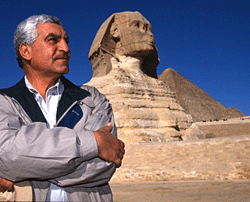
Egypt's antiquities minister, whose trademark Indiana Jones hat made him one the country's best known figures around the world, was fired Sunday after months of pressure from critics who attacked his credibility and accused him of having been too close to the regime of ousted President Hosni Mubarak.
Zahi Hawass, long chided as publicity loving and short on scientific knowledge, lost his job along with about a dozen other ministers in a Cabinet reshuffle meant to ease pressure from protesters seeking to purge remnants of Mubarak's regime.
"He was the Mubarak of antiquities," said Nora Shalaby, an activist and archaeologist. "He acted as if he owned Egypt's antiquities, and not that they belonged to the people of Egypt."
Despite the criticism, he was credited with helping boost interest in archaeology in Egypt and tourism, a pillar of the country's economy.
Read more: http://www.mysanantonio.com/news/article/Egypt-s-iconic-antiquities-chief-fired-1470020.php#ixzz1SSojqQTO
Thursday, May 26, 2011
Egypt's lost pyramids

Some of them, at least. This is the best archaeology story of the day - 17 pyramids found using satellite infra-red survey techniques. Over 3000 settlements and 1000 tombs were also detected. This is a much needed boost to the region's tourist industry. It also clearly demonstrates that there is still a vast amount of material left to be newly uncovered, even in such a well-studied and extensively excavated country.
Read the full story here
Tuesday, April 26, 2011
42 foot tall statue of Amenhotep III excavated

As reported in the news today:
Archaeologists unearthed one of the largest statues found to date of a powerful ancient Egyptian pharaoh at his mortuary temple in the southern city of Luxor, the country's antiquities authority announced Tuesday.
The 13 meter (42 foot) tall statue of Amenhotep III was one of a pair that flanked the northern entrance to the grand funerary temple on the west bank of the Nile that is currently the focus of a major excavation.
The statue consists of seven large quartzite blocks and still lacks a head and was actually first discovered in the 1928 and then rehidden, according to the press release from the country's antiquities authority. Archaeologists expect to find its twin in the next digging season.
Excavation supervisor Abdel-Ghaffar Wagdi said two other statues were also unearthed, one of the god Thoth with a baboon's head and a six foot (1.85 meter) tall one of the lion-headed goddess Sekhmet.
Archaeologists working on the temple over the past few years have issued a flood of announcements about new discoveries of statues. The 3,400-year-old temple is one of the largest on the west bank of the Nile in Luxor, where the powerful pharaohs of Egypt's New Kingdom built their tombs.
Amenhotep III, who was the grandfather of the famed boy-pharaoh Tutankhamun, ruled in the 14th century B.C. at the height of Egypt's New Kingdom and presided over a vast empire stretching from Nubia in the south to Syria in the north.
The pharaoh's temple was largely destroyed, possibly by floods, and little remains of its walls. It was also devastated by an earthquake in 27 B.C. But archaeologists have been able to unearth a wealth of artifacts and statuary in the buried ruins, including two statues of Amenhotep made of black granite found at the site in March 2009.
Monday, June 21, 2010
City of Avaris, discovered by radar


This is what I like to see! Not to be confused with Avarice or Avatar...
Very exciting stuff, locating city remains using radar imaging.
An ancient Egyptian city believed to be Avaris, the capital of the Hyksos people who ruled 3,500 years ago, has been located by radar, Egypt's culture ministry says.
A team of Austrian archaeologists used radar imaging to find the underground outlines of the city in the Nile Delta, a now densely populated area.
The Hyksos were foreign occupiers from Asia who ruled Egypt for a century.
Avaris was their summer capital, near what is now the town of Tal al-Dabaa.
The radar images show the outlines of streets and houses underneath the green farm fields and modern towns in Egypt's Delta.
Egyptian antiquities chief Zahi Hawass said in a statement that the area could be part of Avaris, the summer capital of the Hyksos who ruled Egypt from 1664-1569 BC, during the 15th Dynasty.
"The pictures taken using radar [imaging] show an underground city complete with streets, houses and tombs which gives a general overview of the urban planning of the city," Dr Hawass said in a statement.
Irene Mueller, who heads the Austrian team, said the main purpose of the project had been to determine how far the underground city extended.
"The aim of the geophysical survey was to identify the size of the ancient city and the mission managed to identify a large number of houses and streets and a port inside the city," she said.
"The mission also identified one of the Nile river tributaries that passed through the city, as well as two islands," she was quoted as saying in the statement.
(Story Source: BBC)
Subscribe to:
Posts (Atom)