Monday, June 14, 2010

The Dogu of Japan and the 'Goddess' of Europe


A collection of tiny, broken ceramic feet, ornate goggle-eyed statues and the famed ‘Grimes Grave Goddess’ are among 100 prehistoric figurines going on show at the Sainsbury Centre for Visual Arts next week to enable a comparison between a matching (but totally unconnected) tradition of human model making in Japan and Europe thousands of years ago.

‘Unearthed’ features six ornate Jomon figurines (known as dogu) from Japan which are up to 16,000 years old. The beautifully carved statues are remarkably well complimented by a collection of Neolithic and Eneolithic statues from the Balkans which date back 8,500 years.

The exhibition creators say the comparison of both sets of figures made by villagers in totally unconnected regions, has thrown up “intriguing similarities and differences.” Many of the statues have been made to be hand held and are typically about 5 cm in height (2.3cm at smallest). Both sets are made from similar materials and have breaks in similar places.

"There may never again be the chance to see this many ancient objects from the worlds' two great figurine traditions together in one exhibition. It is impossible to look at these evocative European figurines and Japanese dogu and not be transported to mystical worlds from deepest prehistory,” said the exhibition’s curator Douglass Bailey, of San Francisco State University.

Bailey said the exhibition’s purpose was to question the use of the figurines in both cultures to add to both an historical, anthropological and archaeological knowledge. He wants visitors to ask: What did these objects mean to their makers? Were they goddesses and gods? Were they toys? Were they portraits? To help explore these questions visitors to the exhibition will be given a biscuit-fired figurine by artist Sue Maufe.

“Small things, especially ones that look human, allow us to think about our place in the world in new ways. [The exhibition] develops this notion and creates fresh opportunities for us to reconsider who we were in the past, who we are today, and who we want to be,” said Andrew Cochrane, unearthed curator, University of East Anglia.

'Unearthed' opens on Tuesday 22nd June and runs until Saturday 29th August at the Centre for Visual Arts, University of East Anglia, Norwich www.scva.org.uk

(Story Source)


Aberdeen's archaeological ambitions


An archaeological dig will get underway at the site of an old pond at Aberdeen's Duthie Park today [Monday 14 June 2010].

The dig and restoration of the pond are part of exciting plans to breathe new life into Aberdeen's historic Duthie Park by Aberdeen City Council and the Heritage Lottery Fund (HLF), who are joint funders of a scheme to restore the 44-acre Victorian park to its former glory.

The circular pond, an original feature of the 1883 park layout, is situated in the lower car park area. The pond was infilled in the 1920s when the model yachting pond was extended and laid with turf. The stone steps leading down to the pond from the former terraced walkway were removed in the 1960s.

The first phase of the archaeological fieldwork will include the excavation of 2 trenches across the location of the original pond (to initially assess of the condition and survival of the structure and to identify building materials); and a third trial trench will be excavated across the location of the stone steps leading southwards from the terraced footpath (to assess the level of survival of the steps).

The specific objectives of the fieldwork are to:

  • identify the presence/absence of the 1883 circular pond feature;
  • identify the presence/absence of the 1883 stone steps;
  • determine the condition of any surviving original building materials;
  • identify where original building materials can be reused to form the new elements.

The dig will take a minimum of two days.The second phase will occur if substantial remains of the original pond structure are observed in the trial trenches.

(Story Source)

Norway's mysterious axes


"If one finds something once, it's accidental. If it is found twice, it's puzzling. If found thrice, there is a pattern," the archaeologists Olle Hemdorff and Eva Thäte say.
In 2005 the archaeologists investigated a grave at Avaldsnes in Karmøy in southwestern Norway, supposed to be from the late Iron Age, i.e. from 600 to 1000 AD. Avaldsnes is rich in archeological finds. They dot an area that has been a seat of power all the way back to around 300. Archaeologist Olle Hemdorff at the University of Stavanger's Museum of Archaeology was responsible for a series of excavations at Avaldsnes in 1993-94 and 2005-06.

"It became clear to us quite early that the grave had been plundered. The material in the grave had been messed up and now contained brick and porcelain fragments from younger layers of soil," Hemdorff says.


Plundering of graves was very common in the 19th century and actually legal. It was not until the Cultural Heritage Act in 1905 made it a criminal offence for lay persons to excavate cultural monuments.

Axes and pearls

The German archaeologist Eva Thäte is in the spring of 2010 visiting researcher at the Museum of Archaeology. She is also a guest researcher at the University of Chester in England. The cooperation with Hemdorff started in 2003 when Thäte came to Stavanger in connection with a doctoral work on the recycling of ancient tombs. The latest research project carried out by the two archaeologists is on finds of older artifacts in younger graves. In the grave at Avaldsnes the researchers found seven handsome glass pearls in the dirt.

"In the late Iron Age glass was the most common material for making pearls, and therefore glass pearls are often found in men's and women's graves from this period. The women wore the pearls in a cord around the neck and brought more pearls with them into the grave than men did. The discovery of the seven pearls made us assume that it was a woman's grave we investigated," Hemdorff says.

"But then we suddenly found a stone axe. It was in the same layer of soil as some of the pearls. The axe is from the Stone Age and more than a thousand years older than the pearls! It is a so-called greenstone axe. All the other indicators suggested that the cairn was from the Iron Age and belonged to a buried woman. So why was there an old axe from the Stone Age in the grave?," the archaeologist asks.

Not accidental

During the last three years documented discoveries of artifacts have been made that are typical for the Stone Age -- marks from flint, flint fragments, quarts, axes, etc. in younger burial mounds.

"Unfortunately this documentation did not begin until the 1970s. Up to that date neither archeologists nor grave robbers were aware of these objects. They were just seen as unimportant and without archeological value. It is only now that we are beginning to have enough data for analysis, and we have made many enough discoveries of Stone Age artifacts in younger graves to say that they make a clear pattern," Thäte says.

She points to a good example from Sogndal in Sogn og Fjordane where a stone axe was found in an untouched stone coffin from the 5th century.

"The axe must have been placed there intentionally. Other finds in Scandinavia make this pattern even clearer. In Halland in Sweden they have found a burial site consisting of almost one hundred graves from the late Iron Age where one has registered processed flint objects in nearly every grave," Hemdorff says.

Starting with the finds around the grave at Avaldsnes and taking the other finds into account, it is not likely that the axe ended up in the grave by accident. Why was it deposited there?

Thunderstones from the sky

The researchers say that people back in the Iron Age had a conscious relationship to objects from earlier times that connected them to their past.

"People probably considered old objects as a heritage from their ancestors. Recycling of old burial mounds for new graves is an indication of this relationship. The idea was that the mounds were memories from a distant past, and written sources indicate that recycling of mounds had a double function. Apart from providing a grave for the dead they also legitimized property and rights. People asserted their control over an area by burying their family in a gravesite belonging to their ancestors," Thäte explains.

The archeologists think that people in pre-history were superstitious and that the axe was deposited in the grave as a part of the burial ritual.

"People believed that the lightning created thunderstones and that individuals who owned such stones would not be hit by the lightening," Hemdorff says.

The idea of a rock falling from the sky caused by lightening is known all over the world. It is certainly found in Roman times and it is connected to objects like meteors, flint stone axes and petrified sea urchins.

"According to folklore a flint axe might protect against lightening and function as a kind of charm," Thäte says.

In Northern Europe the old idea of the thunder god Thor, who throws his hammer when lightning strikes, is common property. It was alive all the way up to the 19th century.

"Thor's mission was to protect gods and people against evil and chaos and it was therefore believed that Thor's rocks protected houses and people. Two things seem to be important when choosing thunderstones: The form had to be similar to an axe or a hammer, that is a ground stone or flint, or the stone had to have "flaming" properties, which flint and quarts have," Hendorff says.

Phallus and fertility

"Both the form of the axe and the flint stones to make fire may be associated with fertility. Thor's hammer is clearly linked to fertility and prosperity. The hammer is a phallus fertilizing the soil, which gives it apotropaic quality, i.e. it has the ability to protect against evil and accidents," Thäte explains.

Since people imagined that thunderstones fell to the ground in connection with lightning, it is possible that the rocks incorporated some of the qualities of lightening or had the power to create a bright light.

"Here is a clear pattern once more. We find old artifacts made of flint in the younger burial mounds. Flint had a strong symbolic power. The stones created fire and were seen as important objects. They can also symbolize the power of lightning," Hemdorff says.

The Avaldsnes axe

But now back to the axe at Avaldsnes and the question why it was in the plundered grave.

"If you consider how widespread the idea of thunderstones was all the way up to the 19th century, and how common superstition was, it is not unlikely that the grave robbers left a protective amulet to make up for their misdeed. After all they opened a grave and committed sacrilege. Maybe they hoped that the axe provided protection against the spirit of the dead and their ghosts," Hemdorff says.

More excavations of graves and houses with unusual artifacts and comparing them to data from different places will probably yield an even clearer pattern.

Thunderstones are definitely of great archaeological value.


Stop looting via Google


This is a good news story that began with some exceedingly grim news.

This grim news came to light in the late spring of 2003, after the dust had begun settling from the invasion of Iraq and archaeologists began taking stock of the country’s looted archaeological sites. To measure the severity of the problem and determine when most of it had occurred, Elizabeth Stone, an archaeologist at the State University of New York at Stony Brook, purchased a series of high-resolution commercial satellite images taken of southern Iraq just before and after the invasion. Stone pored over them, examining known sites and measuring the extent of looters’ pits over time. These scars on the landscape can be seen from space.

Much of looting, Stone discovered, occurred just before and just after the invasion. And the total area pillaged, she noted in a 2007 paper in Antiquity, “was many times greater than all the archaeological investigations ever conducted in southern Iraq and must have yielded tablets, coins, cylinder seals, statues, terracottas, bronzes and other objects in the hundreds of thousands.”

It was a grave situation, one requiring intervention from Iraq’s new government, and Stone let everyone know what she had learned. At one point, she flew out to California to give a lecture on the subject at Stanford University, and as sometimes happens, her talk galvanized a young post-doc, Daniel Contreras. Contreras had put in several field seasons as an archaeologist in Peru: he had found the scale of looting there staggering. “You can’t drive down the Panamerican highway without seeing looters’ pits,” he says. “So looting is really never off the radar there.”

Contreras wanted to start quantifying looting in Peru, à la Stone. But satellite photos are pricey, and Contreras couldn’t afford to buy them. So he and Stanford colleague, Neil Brodie, an archaeologist who specializes in looting issues, started casting around for something much cheaper. What they discovered is that Google Earth photos work just fine. So in the current issue of Antiquity, Contreras publishes the results* of his Google Earth study of looting in Peru’s Vir’u Valley, concluding that a whopping 116 acres of sites in this relatively small valley show intensive damage.

Ok, I know, this still doesn’t sound like good news. But I thought Contrera’s study was ingenious, so I called him up this week to talk about it. Just before hanging up, I asked him whether this might be the beginning of a much larger project, one that enlists the sharp eyes of the Google Earth community and anyone else with an interest in archaeology to keep an eye on the world’s looting hotspots. Could archaeologists crowdsource the monitoring of the our collective archaeological heritage?

“Definitely,” he said, without a moment of hesitation. In fact, he’s now thinking of how to go about doing just that. The technology is all there, he said, it’s just a question of how to administer it. “And I think this would make people a little more aware of the problem of looting, as well as providing a tangible source of documentation for archaeologists.”

Facts and figures of this type are exactly what archaeologists need the next time they press for stricter laws on the looting and sale of antiquites. And I think this new Google Earth study is very good news.


*Antiquity
Volume: 84 Number: 324 Page: 544–555
Huaqueros and remote sensing imagery: assessing looting damage in the Virú Valley, Peru
Daniel A. Contreras*

*Archaeology Center, Stanford University, P.O. Box 20446, Stanford, CA 94309, USA (Email: dcontre@stanford.edu)
This article presents a new initiative in combating looting from the air, building on previous work in Iraq and Jordan. Looted sites in the Virú Valley, Peru, are visible as pit clusters on dated versions of Google Earth. Compare these with earlier air photographs and Gordon Willey's famous survey of the 1940s, and we have a dated chronicle of looting events. This makes it possible to demonstrate that modern looting is certainly taking place and linked to an upsurge in the antiquities trade. As well as being a new instrument for managing heritage, the author shows that the looting survey offers an important research dividend: the location of cemeteries not previously systematicalldocumented, with potential for more thorough investigation even of already looted areas.

How Columbus sailed the ocean blue


A replica of Christopher Columbus' famous ship will be dropping anchor in Peoria next month.

The Nina has stopped in Chillicothe and Peoria several times in the last 15 years, but this year the wooden, sea-going vessel is back - this time with its sister ship, the Pinta.

The replica ships will dock from July 9 to July 12 at the RiverPlex landing adjacent to the Spirit of Peoria.

"Little children love scrambling around the ships, and school-aged children study Columbus and his ships," said A.J. Sanger, a spokesman for the Columbus Fund. "Older people can appreciate and admire the work that went into building (the ships) ... and think about how small (it was) for men to go to sea in."

The Nina was built completely by hand and without the use of power tools in Bahia, Brazil, in 1992, the 500th anniversary of Columbus' entry into the new world. Archaeology magazine dubbed it "The most historically correct Columbus replica ever built." The boat is 93 1/2 feet long and about 52 feet tall and was featured in the film "1492."

The Pinta is a larger version of the Nina, which allows it to accommodate more people at one time.

The Pinta's deck length is 20 feet longer at 85 feet, and its sail area, about 3,800 square feet, is more than twice that of the Nina. It holds a 40-foot air conditioned main cabin below deck with seating and is available for private parties and charters.

Both ships are on tour year-round, stopping at ports across the country and offering sailing museums that feature not only Columbus history, but the history of the Caravel, a type of ship used for decades in the Columbus' era to explore the world.

The Nina and Pinta will be coming to Peoria from Hammond, Ind., and going to Burlington, La.

The last time the Nina docked in Peoria in 2007, visitors to the ship numbered between 8,000 and 10,000.


Aero Archaeology


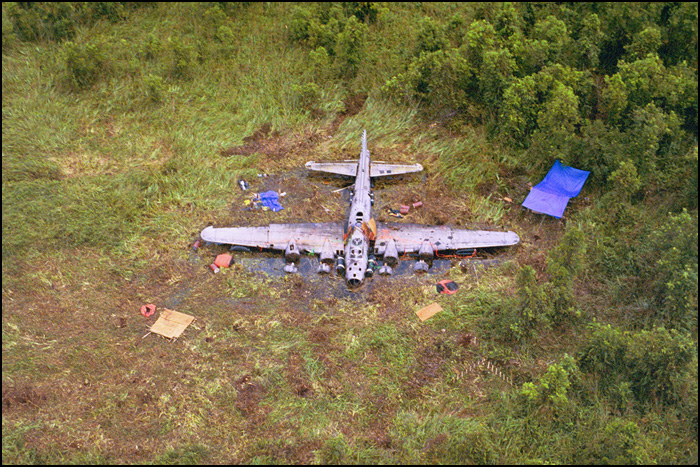
It's a sacrifice Americans said they would never forget. And today, more than 68 years since a group of young U.S. servicemen in a B-17E Flying Fortress crash-landed in a primitive New Guinea swamp, a group of the air crew's surviving relatives and supporters will welcome home the fallen aircraft to honor the heroes of World War II.

A formation flyover by a vintage P-51 Mustang and P-40 Warhawk above the Long Beach Harbor will launch a ceremony to unveil the recovered bomber, nicknamed Swamp Ghost and known by historians as the Holy Grail of military aviation. A flag presentation by the U.S. Air Force Honor Guard and remarks from recovery team members will highlight the event, to be held at 10:30am in the parking lot of The Reef restaurant, 880 Harbor Scenic Drive, where the plane's remarkably intact front fuselage will be on display.

First spotted by an Australian Air Force crew in 1972, the incredibly difficult efforts to salvage and export the plane were initiated by the late Specialty Restaurants Corp. founder, World War II veteran and antique aircraft collector David Tallichet in the mid-1980s.

John Tallichet, president and CEO of Specialty Restaurants Corp., said of his father's life work, "My father was a young B-17 pilot flying out of England with the Bloody 100th Bomb Group during World War II. He never lost his passion for aviation or love of his combat aircraft, the venerable Flying Fortress. Sadly, my father could not be here to witness his dream fulfilled. However, my family is honored to continue his vision of preserving this invaluable relic of aviation history for the benefit of future generations."

In 1996, aircraft salvage efforts were carried forward by Aero Archaeology founder and aircraft recovery enthusiast Alfred Hagen, who has located seven missing World War II aircraft and returned more than a dozen missing in action airmen to the U.S. for burial with full military honors. "Much of my work has been to honor those whom we have come to know as the 'Greatest Generation' and we look back on their accomplishments for inspiration," said Hagen.

Unfortunately, the aircraft's last four surviving crew members died shortly before Swamp Ghost returned to the U.S., one of bombardier Richard Oliver's last wishes. His death last year denied him the privilege of seeing his warbird come home, but his widow Linda Oliver will attend the ceremony in honor of her late husband. A handful of other air crew family members will also be present.

Swamp Ghost will be restored, possibly to flying condition, for permanent display at an aviation history museum. For more information, high resolution photos or video, visit http://aeroarchaeology.com/.


3000 year old Native American Settlement at Pig Point


When they first detected traces of an 800-year-old wigwam on a bluff over the Patuxent River last year, archaeologists celebrated what they said was the oldest human structure yet found in Maryland.

Now, deeper excavation at the site — the front lawn of a modest rental house — is yielding details of much earlier settlement, extending its history back to at least 3,000 years ago.

"As far as I know, it's older than anything in Maryland, Virginia and Delaware, perhaps the oldest structures in the Chesapeake region," said Ann Arundel County archaeologist Al Luckenbach, leader of the dig.

And that's just the age that's been established by carbon 14 dating. Slicing deeper in the sandy bluff overlooking the Patuxent's broad marsh, Luckenbach's crew has found stone tools suggesting humans were exploiting the river's abundance as long as 10,000 years ago.

Called Pig Point, the site is producing a gusher of ancient artifacts —decorated pottery, tools crafted from stone and bone, ornaments and food waste that have begun to fill in the details of life along the Patuxent River centuries before Europeans arrived.

"Some of the ceramics that have come out of this site are really just astounding," said Maureen Kavanagh, chief archaeologist at the Maryland Historical Trust and a specialist in ceramics.

There have been pot fragments with incised angular decorations or rims crimped like a pie crust — both different from any ever found in Maryland. Diggers found an intact paint pot the size of a child's fist, and a miniature, decorated pot the size of a thimble.

"These really have us scrambling to figure out what they represent," Kavanaugh said. "Some of these artifacts are one of a kind, and we don't have an easy way of fitting them into our mental template … It's a great, great site."

Archaeologists say some of their discoveries are so exotic in this region, they suggest Pig Point was a center of trade among native people as far-flung as Ohio, Michigan and New York.

Even today, the town site overlooks broad expanses of wild rice and Tuckahoe — river plants that would have helped to feed the native people. Geese, heron, osprey, bald eagles still patrol the shores. Tiny fish roil the shallows.

Trash middens unearthed in the dig are yielding the remains of freshwater mussels, oysters, fish, beaver, muskrat, otter, deer, duck, nuts and more. Archaeologists have also found carbonized corn kernels, evidence of agriculture.

"It's one of the biggest marshes on the East Coast. You couldn't have starved here if you tried," Luckenbach said


Trained in prehistoric archaeology, but best known for leading excavations of Anne Arundel County's colonial-era "Lost Towns," Luckenbach said Pig Point has changed the arc of his long career as the county's chief archaeologist.

"I've been waiting 20 years for the right Indian site," he said. "And here we are at Pig Point."

Work at the site began in April 2009, after the owner, William Brown, contacted the county archaeology office about the artifacts he'd been finding. The dig began soon after in the front yard of a rental home on the property.

"This has made me very happy," Brown said of the dig, which he has joined as a volunteer. "It's my opportunity to learn about the people who lived here before us. I'm fortunate I have the time to be here with them, and through every step of it."

Funded this year by Anne Arundel County and a $32,000 grant from the Maryland Historical Trust, the work at Pig Point has astonished Chesapeake archaeologists, who rave about the fine preservation of artifacts and deep layering of the soil.

"Archaeologists just live for these nice, layer-cake sites where the oldest [artifacts] are the most deeply buried, until you get to the modern stuff on top," said Richard J. Dent, professor of anthropology at American University in Washington.

Overland Trade Route Evidence - China and Persia

Based on the analysis over the ancient glasses, it is concluded that the goods originated from Persia, referring to their particular colors of blue and green. The broken glasses are among other findings considered the oldest. "The findings prove that Middle East trade routes in the ninth century passed by silk road starting from India, Strait of Malacca, eastern coast of Sumatra, northern coast of Java and Maluku. At that time of years, the merchants bought spices from Indonesia," he said.

Meanwhile, an archaeologist from the National University of Singapore, Prof John Norman Miksick, explained that data recording the overland trade routes of the ninth century is still rare. "It is only within these last 15 years that new historical evidences have been found on the land, one of which is from Dieng," he said.

Dieng plateu, according to Head of the Department of Archaeology of Gadjah Mada University, Prof Inayati Adrisiyanti, is only known as home for temples. However, the findings emphasized the economic activities of the locals in the ninth century.

Four Castles Found in Turkey - 2nd Century BC


A group of American archeologists found ruins of four ancient castles dated back to the 2nd century B.C. in western Turkey.


The group including 16 students from the universities of Boston, Pennsylvania and Brown led by Assistant Professor of Archaeology Christopher H. Roosevelt has been searching for ancient ruins in Golmarmara town of the western province of Manisa upon permission of the Turkish Ministry of Culture & Tourism.

In an interview with the Anatolia news agency on Monday, Roosevelt said that he had directed an archaeological project across central Lydian landscapes for the past five years.

"Our findings indicate that the castle could belong to the Arzawan kingdoms of Seha River Land. We believe that the castles constituted a settlement network. One of them could be the biggest castle built in western Anatolia during the period. The castle is four times bigger than the Troy castle. We may have discovered the capital of the Seha River Land," he said.

Roosevelt said that they were planning to apply to the Turkish Ministry of Culture and Tourism to get permission for archaeological excavations at the site.

As a specialist in the archaeology of western Anatolia (Turkey), specifically that of the ancient kingdom of Lydia, Roosevelt has directed the Central Lydia Archaeological Survey (CLAS), a project that investigates cultural and environmental dynamics across central Lydian landscapes since 2005. He published "The Archaeology of Lydia, From Gyges to Alexander" providing the first overview of the regional archaeology of Lydia in western Turkey. The book includes much previously unpublished evidence and a fresh synthesis of the archaeology of Sardis, the ancient capital of the region. (Story Source)

Sunday, June 13, 2010

Ahoy Smithsonian - Them be some pirate bones


After a trip to the Smithsonian Institute for examination, the remains of a man believed to have been a member of Blackbeard’s pirate crew likely will be reinterred in Beaufort County.
The findings will become part of the museum's work studying what human bones tell about the early European and African settlers in the Mid-Atlantic


Wednesday, June 9, 2010

World's Oldest Shoe


http://www.dailymail.co.uk/sciencetech/article-1285331/Is-world-oldest-shoe-5-000-year-old-leather-laced-boot-cave-Armenia.html?ito=feeds-newsxml

A 5,000-year old leather shoe, found in Armenia, may be the oldest shoe ever found.

This item does not seem to be decorated, so would appear to have been purely functional,

The excellent preservation (including the lace) is due to the unusual conditions of the cave where it was buried (along with pots of food and a child's skeleton).

Galileo once more gives the Vatican the Finger


http://news.yahoo.com/s/ap/20100608/ap_on_re_eu/eu_italy_galileo_s_fingers

The 18th century was a curious time, when it was deemed acceptable to remove the fingers of the corpse of 17th century Italian Galileo Galilei (astronomer, physicist, mathematician, philosopher and flautist!)... the man who got in big trouble with the Catholic Church for saying the Earth spun around the Sun.

Two fingers belonging to Galileo are now on display in Florence at the Galileo Museum (previously the Museum of the History of Science - the new name is snappier!)

The display has the fingers' back to the Vatican, allegedly, symbolically telling off the Church.

Hunter, Gatherer, Farmer, Couch Potato


http://www.independent.co.uk/news/science/spencer-wells-at-root-were-still-hunters-1993055.html

One man's view on how farming has destroyed humanity. I tend to not agree.
It is an interesting idea, and has much merit, but is, ultimately, deeply flawed. There seems to be an abundance of selective evidence-picking! And using the Pandora imagery is just CHEESY!

From the article:

. "Many of the crises we see in the 21st century, I would argue, have their roots in the dawn of the Neolithic," he says. "We spent an enormous amount of time as hominids and as primates living as hunter-gatherers. That is the natural way for us to live, and we're suddenly living in this profoundly unnatural way, and we're still in the process of adapting to it and working out how to live with it."

The shift from a hunter-gathering lifestyle to an agricultural way of life, he believes, has not just led to many of the environmental problems we face today, it has caused some of dire medical disorders, from infectious diseases and obesity to the mental illnesses that are rampant in modern, urban living. "Since we settled down, population density increased massively. We became sedentary and the foods we ate changed enormously from the days we were hunter-gatherers," he explains. "We were once used to living in groups of no more than about 150 individuals. Now we live in cities of millions and the cultural cacophony creates a feeling of unease and we are seeing evidence of that with the rise of mental illness."

Despite the immense problems facing the human species in the 21st century, Wells believes there is hope – what he calls "Pandora's seed". When Pandora opened the box, she at least had to slap it shut fast enough to contain hope. "The hope is that humans are innately innovative and that we can innovate very rapidly when we're forced to," Wells says. Our one hope for continued survival, he seems to suggest, is the innate creativity of the same large brain that arguably helped to create much of the mess we find ourselves in today.

I think, therefore I search Google


A google search has led to the return of a long lost letter written by Descartes. Stolen over 150 years ago by an entrepreneurial count in Italy, the letter found its way to a university in the states (who have since returned it to France).
In return, the French Institute awarded Harverford College a €15,000 grant. Win win!

Tuesday, June 8, 2010

The Lost World of Old Europe


The Ashmolean Museum has a fantastic new exhibition looking at the Danube Valley, 5000-3500BC. The exhibition runs until the 15 August - better book my train ticket!

Although archaeological work has taken place in the region since the end of the 19th century, there is little awareness of the wealth of its prehistoric cultural heritage due to the confines of the late 20th century ‘Cold War’.

Experimental Archaeology


I love this idea!

Bury some food items, leave them for a while to fester, then excavate the lot so you know how things decompose - all with the knowledge of what everything was to begin with.
It's not just the physical remains that you can test, but also the chemical traces of the surrounding soil. Very useful stuff!

Religious Artefacts from Israel - 1,500 BC


http://www.google.com/hostednews/ap/article/ALeqM5gdQhVlK9zDvOfGPHAETGNckH3sfAD9G6LGM00

Gas line excavations have led to this wonderful discovery - a purposefully buried collection of objects ranging from ungent bottles to decorated pots

Gladiators in the UK


http://www.guardian.co.uk/science/2010/jun/07/york-gladiator-graveyard

Whether they looked like Russel Crowe or not is unknown, but a good artist's rendering based on the skulls should clear that up

Historic Chemical Burns


Let this be a warning to treasure hunters! (and a heads up for fishermen)
http://wbztv.com/local/chemical.boat.fishermen.2.1738256.html

Maritime Archaeology - Historic Shipwreck


http://edition.cnn.com/2010/US/06/05/oldest.shipwreck/index.html?hpt=C1

A ship found by a treasure hunter...sigh...
But at least the local North Carolina archaeology troop are going to attempt to preserve the vessel. It dates from the 17th century and is the oldest shipwreck found in the area.

This discovery shows that you don't need to excavate to discover archaeology - a storm can do all the digging for you!